
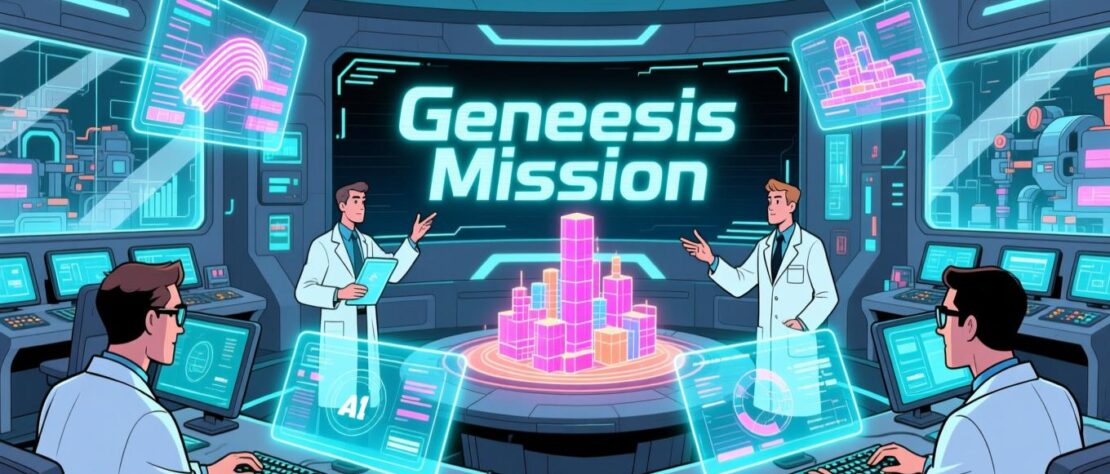
The United States has announced a major national initiative — the Genesis Mission — designed to harness artificial intelligence to accelerate scientific discovery, modernise research infrastructure, and strengthen the country’s technological edge.
Unveiled by the White House, the mission aims to unlock the vast research datasets, computing power, and high-performance infrastructure held across federal agencies. Officials say the initiative represents one of the most ambitious science-and-technology efforts undertaken by the US government.
Calling the project a moment of “historic urgency,” the presidential order compares Genesis to the scale and national mobilisation of the Manhattan Project. The initiative focuses on deploying AI-enabled scientific models, autonomous research agents, automated laboratory workflows, and advanced hypothesis-testing systems.
Department of Energy to Lead New AI Research Platform
Under the directive, the Department of Energy (DOE) will spearhead the mission by developing the American Science and Security Platform, a unified ecosystem offering access to supercomputers, secure scientific datasets, advanced AI frameworks, and tools for autonomous experimentation.
A strict rollout timeline has been set:
- Within 90 days: Identify and integrate major computing, storage, networking, and cloud resources across DOE labs.
- Within 120 days: Submit an initial portfolio of priority datasets and scientific models.
- Within 240 days: Review national laboratory capabilities for AI-augmented research.
- Within 270 days: Launch a working prototype of the platform targeting one national science challenge.
More than two dozen national science challenges have been identified — from biotechnology, quantum science, and microelectronics to critical minerals, nuclear energy, and advanced manufacturing.
Leadership, Strategy, and National Coordination
President Donald Trump has placed overall command of the mission with the Assistant to the President for Science and Technology (APST), who will coordinate activity through the National Science & Technology Council (NSTC). The APST will also shape strategy, oversee funding incentives, and build partnerships with national labs, universities, and private-sector technology leaders.
The mission aims to mobilise the country’s sprawling R&D ecosystem — including DOE laboratories, major academic research centres, and leading tech companies — to build scientific foundation models and AI agents capable of autonomously exploring hypotheses and accelerating discovery.
According to the order, the goal is to “dramatically accelerate scientific discovery, strengthen national security, enhance US energy dominance, and expand the return on taxpayer investment.”
Funding, Collaboration and Governance Framework
The directive establishes several mechanisms to drive collaboration and innovation:
- Cooperative R&D agreements
- Prize competitions to spur breakthroughs
- Standardised frameworks for data and model sharing
- Clear guidelines for IP licensing, export controls, and data security
The mission also highlights the importance of responsible AI development, calling for rigorous data governance and secure scientific workflows.
Annual Review and Accountability
The DOE Secretary is required to deliver an annual progress report to the President, detailing:
- Platform performance
- Integration across national labs
- User participation
- Research outcomes
- Collaboration with public and private partners
The Genesis Mission marks a major push by the US government to place AI at the core of scientific innovation, with the potential to reshape research across energy, health, manufacturing, defence, and advanced technologies.